
BY TAYLOR GIORDULLO
Johnny Mac Brown stands in the harsh spotlight watched by the alert and curious eyes of Mariemont’s students. He holds above his head a single item easily recognized by everyone in the room: a cellphone. But the question he poses is not one the staff and students are accustomed to hearing.
“Why do so many people die from this?” he asks.
Two weeks ago, Mr. Brown and his wife Jeanie Brown from the Remember Alex Brown Foundation came to visit and explain the dangers of texting and driving. Their prime example: their daughter.
On the morning of November 10, 2009 Alex was driving too fast down a winding road in her hometown of Wellman, Texas. But instead of keeping her eyes on the road, her attention was diverted by text messages, both sent and received. She didn’t even see it coming. Later that morning Mrs. Brown found her daughter’s crushed car, which had completely rolled once, and Alex fighting for her life outside on the ground nearby. Her mother rushed her to the hospital, but she didn’t make it.
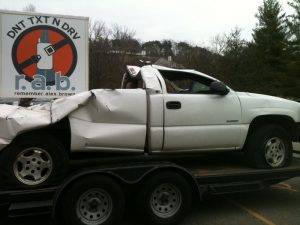
- The car that Alex was driving the day of the wreck was brought to Mariemont High School to show the students the consequences of texting and driving.
Caty Jevic, sophomore, has only been driving for three months, and the assembly has opened her eyes to the harsh realities of being on the road.
“Once I texted my dad while driving out of the school,” Jevic says. “The assembly scared me so badly that I will never do that again.”
Kaila Roberts, senior, has about two years of driving experience under her belt. And yet, her familiarity behind the wheel has not made her any less affected by the assembly.
“I have never texted and driven before, but now I am way less likely to do it in the future,” she says.
However, unlike Roberts and Jevic, senior Hanna Reeder has openly admitted to texting quite a bit while driving.
“It’s not really the fact that I thought I was above something like that crash to happen, I just never processed it was that big of a distraction.”
While Reeder may not have realized it before, according to the the Remember Alex Brown Foundation, drivers are 24 times more likely to crash while texting and driving. That is six times more likely than if someone is driving under the invluce of alcohol. Ever since these facts have been relayed to the students of Mariemont, Reeder has sworn off of using her phone while in the car.
“I keep the pledge sheet and bumper sticker (items handed out at the end of the assembly) on my dashboard so it’s always right in front of me when I’m driving,” explains Reeder. “It reminds me not to go for my phone when it rings.”
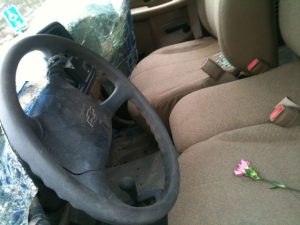
- The inside of Alex Brown’s car after the wreck that took her life.
A phone is meant for taking and making calls, sending and receiving texts, and the occasional game of Angry Birds. But Mr. and Mrs. Brown have made the students of Mariemont see that it is so much more than that. Whether it is an iPhone, Blackberry, or Droid, it has the ability to take a life. The words of Mrs. Brown have made students realize this.
“If you are going to continue to text and drive, pull out a notebook and write what you want at your funeral,” says Mrs. Brown.